
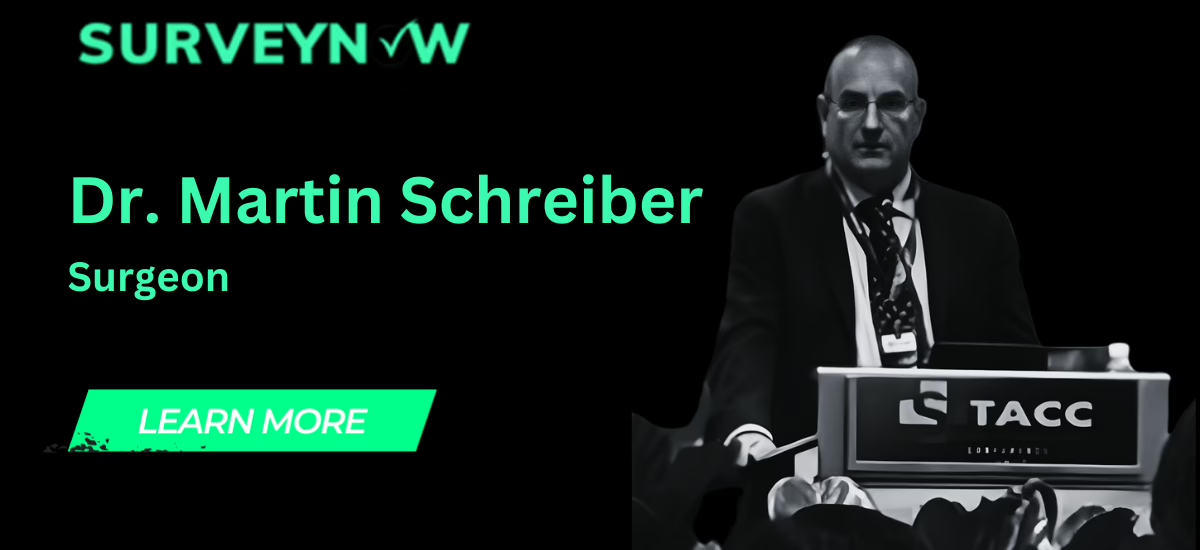
Dr. Martin A. Schreiber has worked at the intersection of trauma surgery, military medicine, and academia for more than three decades. During that time, he has served in leadership positions within major civilian trauma centers, directed national military trauma programs, and conducted large-scale research projects for the Department of Defense. In addition, he has mentored numerous surgeons, authored extensive publications, and had a major influence on how trauma systems operate in both civilian and combat environments.
What sets Dr. Schreiber’s career apart is not a single role, but the continuity of similar themes across the various roles he has held. Regardless of whether he was deployed to combat zones or working in an academic hospital operating room, his work has consistently focused on understanding why patients die from traumatic injury and how trauma systems can be developed to prevent those deaths.
In this interview, Dr. Schreiber discusses the experiences that influenced his career, the challenges of designing trauma systems, and how he defines success in a field where the best outcomes are not always visible.
Tell us about your background and what first led you to trauma and critical care surgery.
I started out with a strong interest in science, earning my bachelor’s degree in chemistry from the University of Chicago in 1984 before going on to medical school at Case Western Reserve University, where I received my MD in 1988. Early in my career, I joined the U.S. Army Reserve, which led me to complete my surgical internship at Madigan Army Medical Center. From there, I moved to the University of Washington for my general surgery residency, where I served as chief resident and later completed a fellowship in trauma and surgical critical care.
I was drawn to trauma and critical care because of the immediacy of the work. Trauma forces you to make decisions quickly, often with limited information, and to truly understand how the body responds under extreme stress. During my residency and fellowship at high-volume centers like the University of Washington and Harborview Medical Center, it became clear to me that good trauma care is about much more than technical skill in the operating room. Outcomes depend on timing, coordination, and how well the entire system functions at peak pressure. That combination of medicine, systems thinking, and my early military experience has ultimately shaped my commitment to this field and kept me engaged throughout my career.
You trained and practiced during periods of major change in both civilian and military medicine. How did that shape your approach?
My education and training took place at high-volume institutions, including the University of Washington and Harborview Medical Center in Seattle, which provided opportunities for rigorous academic investigation into trauma care. At the same time, my military service exposed me to the stark contrast between providing care in combat versus non-combat environments. In combat, injuries are often extreme, resources are limited, and delays in care are frequently fatal.
These experiences highlighted the importance of flexibility in trauma systems. While patient physiology remains constant, the environment in which care is delivered does not. Trauma systems must therefore be designed to adapt to changing conditions and constraints.
You have held leadership roles in both civilian hospitals and the Department of Defense. What stands out about those experiences?
Preparedness stands out as one of the greatest challenges. Civilian trauma centers generally maintain enough volume to preserve surgical proficiency. In military settings, particularly during peacetime, maintaining that level of readiness is more difficult. This reality has made military-civilian integration increasingly important.
Programs that allow military trauma teams to train in high-volume civilian trauma centers help preserve skills, reinforce teamwork, and maintain readiness. In the end, both civilian and military systems benefit from this integration.
What led to your involvement in developing military-civilian trauma integration programs?
Military trauma teams will continue to need ongoing exposure to high-level and complex trauma cases to be effective. Because of peacetime conditions, military surgeons and trauma teams are typically exposed to fewer trauma cases than they would experience during wartime; this limited exposure could decrease their effectiveness individually and as teams due to less case complexity and frequency.
As a result, high-volume civilian trauma hospitals offer the case complexity and frequency that are missing in most military trauma hospital systems during times of peace. To fill this void in peacetime training, programs have been developed to provide training to military teams in real-world clinical environments as part of their overall preparation for future combat. The Army Military-Civilian Trauma Team Training Program is one example of these programs.
Much of your research focuses on hemorrhage control and damage control resuscitation. What prompted that focus?
When we analyzed preventable trauma deaths, a clear pattern emerged. Uncontrolled hemorrhage was the leading cause of preventable death. This finding challenged long-held assumptions about trauma priorities.
We found that earlier hemorrhage control and improved resuscitation strategies could significantly improve survival. Research allowed us to examine these ideas systematically and move from intuition to evidence-based practice.
You have led or participated in numerous research initiatives. How do you view the role of research in trauma care?
Research is essential in trauma care because the field has historically relied too heavily on tradition. Data allow us to question assumptions and measure what truly improves outcomes.
Given the complexity of trauma systems, research provides the evidence needed to determine whether system-level changes are meaningful. Evidence-based practice allows trauma care to evolve rather than remain static.
You often emphasize systems over individual performance. Why is that distinction important?
The root cause of preventable deaths in the realm of trauma care is typically not due to an isolated act of one person making an error. The most common causes of preventable deaths in trauma care can include delays in care, poor communication between parties involved, or poorly designed processes for care delivery.
Improving an individual’s performance on their own will not resolve the issue if the system is producing consistent delays; therefore, you must examine and redesign the system itself.
How do you define success in trauma care and trauma system leadership?
Success in trauma care is often quiet. It appears as smooth coordination, timely decisions, appropriate priorities and fewer delays. When trauma systems function well, there is often little to draw attention as excellent results are an expectation..
Often, the absence of failure is the strongest indicator that a system is working as intended.
What has remained consistent throughout your career, despite the different roles you have held?
Reducing preventable delay has been the constant theme. Whether I was working in combat zones, academic hospitals, or research programs, the same question kept resurfacing: where does care slow down, and why?
Answering that question requires looking beyond individual actions and examining how the entire system is designed.
What advice would you give to those entering trauma surgery or critical care today?
Start with the fundamentals. An understanding of physiology matters more than any single technique or piece of technology. When you truly understand how the body responds to injury, everything else makes more sense. Just as important is learning to work as part of a team. Trauma care is never a solo effort. Outcomes depend on how well surgeons, nurses, medics, and support staff function together.
The focus should be early hemorrhage control and transport to surgical capability as fast as possible. Hemorrhage control starts in the field with laymen applying pressure dressings and tourniquets based on their Stop the Bleed training or medics providing first aid. EMS should focus on getting patients to surgical capability as fast as possible with no delays and surgeons need to focus on finding sources of blood loss and controlling them immediately. Resuscitation should be blood based and be similar to what the patient is losing like with whole blood or blood components in ratios similar to whole blood.
Over the years, whether leading combat teams overseas or working in busy civilian trauma centers, I’ve noticed that coordination often matters as much as clinical skill. No one succeeds alone in trauma care. It takes a village to provide expert care from start to finish for even a single trauma patients
It’s also important to understand that preparedness is not something you achieve once and keep forever. Skills fade without regular use. That reality is why real-world training and ongoing exposure are so important. Continuous training, honest evaluation, and a willingness to adjust based on evidence are essential. Trauma care continues to evolve, and the people who stay adaptable and open to new data are the ones who make the greatest impact.
What challenges in trauma care and preparedness remain unresolved?
Trauma remains dramatically underfunded given its impact. It remains the leading cause of death for younger Americans, yet it receives far less research support than many other conditions. That gap affects everything from innovation to system readiness.
We have made real progress in civilian and military collaboration, and those efforts have improved outcomes. But gaps remain, especially in sustained national coordination and long-term funding. Trauma care is not just a medical issue. It is a preparedness issue. It reflects how well a society is equipped to respond when systems are stressed.
Whether the situation involves mass casualty events, combat injuries, or everyday trauma, the same truth applies. Systems need to function when resources are limited and time is short. Solving these challenges will require long-term investment in research, training, and infrastructure, along with policy support that looks ahead rather than reacting after losses occur.
Conclusion
Martin Schreiber’s career reflects the evolution of trauma care from isolated clinical practice to integrated system design. Across civilian hospitals, military medicine, and research institutions, his work has focused on identifying why preventable deaths occur and how systems can be structured to reduce them.
Rather than emphasizing individual heroics, Dr. Schreiber’s perspective highlights preparation, coordination, and evidence. His legacy is not defined by a single program or publication but by a broader shift in how trauma care is understood. Trauma outcomes improve not only when conditions are ideal but also when systems are designed to function under pressure, ensuring that delays do not become the deciding factor between life and death in the next crisis.
Disclaimer: This article is for informational purposes only and highlights Dr. Martin Schreiber’s professional experiences and perspectives in trauma surgery, critical care, and military-civilian integration. It is not intended to provide medical advice or treatment recommendations. Portions of the interview have been edited or paraphrased for clarity, readability, and engagement while preserving the original meaning and intent.